WORLD WAR-I IN ROMANIA
It is not my intention in these reminiscences to give a history of the war of Greater Romania. A better source of details is a book by Constantin Kiritescu, published in three volumes in 1921, by Casa Scoalelor. What I will do is to limit myself to those episodes in which I participated.
On October7th, 1915, In was nineteen years. Old when Prince Carol came to me with an offer: "If you enlist as a volunteer, come to my regiment of "Hunters" of which I am its Commander in Chief.?
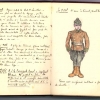 A day later, dressed in the Hunter’s uniform of the ?Queen Elizabeth? No.2 Regiment, I joined Company One commanded by Carol. Without losing any time, he ordered Sergeant Chiritza to train me in everything that he had already trained recruits of the prior year. Chiritza treated me as any other soldier. He taught me to stand straight, head up, chin pulled in, to draw in the stomach and keep my heels together and toes apart to form a "V". I learned the parade step, how to turn to the right and left. Somehow what was most difficult for me was to turn around from the left. His greatest contribution was to teach me how to execute an order. I had to start by saying: "Yes Sir, sergeant, I understood. I have to go to the store and bring you a packet of cigarettes."
The first time I came back empty handed, he not having given me any money. He repeated the order. I went back to the store (not too far) and came back with a packet of cigarettes that I paid for out of my own allowance. This order was repeated twice a day and after two weeks Sgt. Chiritza brought me in front of Prince Carol praising me as a good soldier.
At lunchtime while I was in my barracks Prince Carol sent me an invitation to go and have lunch with him in the officers mess hall. In the middle of the table there was a bowl where anyone who spoke of work would drop a fixed sum. With the money collected they bought one or two bottles of champagne! The meals were very good and Prince Carol often held a lively conversation with his officers. He was greatly amused by stories or indecent jokes recounted by Captain Nicolceanu who later would become Prefect de Police of Bucharest. I kept silent. I was the youngest in my class and did not know any indecent stories, nor did I enjoy them.
I had an advantage making me different from the others in my company. I was a "teterist" (a young man with a reduced term of service). This title was given to all high school graduates and I received this title with honors for being ranked first in my graduation examination. What had helped me was the thirty minute speech I delivered on the "History of Aviation,? a topic I selected from a list of ten. I had read almost everything I could about the progress of aviation and I spoke without any notes in a declaratory tone. What produced a sensation was my prophetic peroration. In rhetoric class I had learned that a good speech should end with a dramatic closing message. I said that in a far away future, mankind will become poor as the soil would lose its natural resources and our salvation would be to board a large aircraft and fly to another planet (that was in1915). The President of the Commission, Professor Titeica, came up to the podium and congratulated me. He asked where I got the idea of my closing line and laughed when I said I found it in my head.
I did not stay long in the Hunters regiment because the Commander asked Prince Carol to transfer me to the reserve officers Military School for specialized training. I packed all my military belongings and was driven in a horse carriage to the Military School in Dealul Spirei with an order of service signed by Prince Carol.
My arrival at the school in the uniform of a "Hunters" soldier produced a sensation and hilarity. There were over 800 students in the school. The reserve officers, many well educated, wore the uniform of the Infantry Regiment. As France and Germany were already at war, all the Romanian students who were at Universities in those countries, were obliged to return to Romania. As they arrived home they were all drafted as their exemptions were invalidated. We others, who were only high school graduates, were considered to be "insects". One of my "insect" colleagues, Ghita Harsu, whose mother Mrs. Hodos was a well-known writer, had assumed the role of making fun of all the "doctors" from Paris and Heidelberg whom he nicknamed "intellectual lice!" My presence among the insects and the lice made me realize how inferior I was. These colleagues had a Western culture and were better prepared than I was to get a job or practice a career. But the officers who were our instructors saw no difference. They treated us all alike as militarily unprepared.
One day, were all gathered in the school amphitheatre where the Commander, Colonel Sturdza, gave us a problem to consider: "A soldier has five bullets in his rifle. If he shoots four how many are left?" We were ordered to answer immediately on a piece of paper. There was a general murmuring in the room. We all felt insulted about a problem of arithmetic at the level of a child in the first grade. But, we did it and a week later we were again gathered in the amphitheatre, where Col. Sturdza read the results. Out of 800 students, not two gave the same answer. The majority made out of this simple problem stories of two or three pages! In Colonel Sturdza’s opinion we would be taught to give the same answer in short, precise words: 5 – 4 = 1. Every morning for one year, we repeated: ?5 – 4 = 1?.
We did military exercises independent of the weather. Sunshine, rain, or snow, we were on a plateau. We were divided by companies and platoons, Ghita Harsu and I were at the tail of the first Platoon of the first company. We were commanded by Lt. Dumitrache, who later became a famous general.
I cannot say we were abused but we were disciplined into achieving a unity of thought. During the year I went through all a soldier’s emotions and received promotions to corporal, then sergeant and before the end of the year to sergeant major. This last title gave me the right to wear a huge sabre. Here too, I competed with one of my colleagues, D. Vechiu, later a well-known newspaperman. To our satisfaction we both graduated at the end of the year as head of our units.
Towards the end of our training, we practiced for the march that we of the Military School would perform at the May 10th parade. In my platoon, I was placed on the right so my duty was to look straight ahead while the others did "eyes right", to honor the King who would be reviewing the troops along Kisseleff Avenue.
The day before was Sunday, and my father insisted we should all attend family lunch, as he liked this. He took great pleasure in presiding over these family gatherings. Usually he was very entertaining with his stories, for he was a good speaker. On that Sunday he told us about his morning walk to the Botanical Gardens which was one of his favorite walks. This Garden was actually a park on Cotroceni Avenue and was very well kept, but there were very few visitors. The fact that it was called Botanical Gardens, discouraged people from visiting it.
Father told us that while he sat on a bench, he heard a cuckoo bird sing nine times, which meant he would live nine more years. This is an old saying and we told him jokingly that he would live for another ninety years! After lunch, he asked me about the parade and said he would watch me from the street. The next day, before leaving for the parade, my younger brother came running to the Military School to tell me to return home at once as my father had been taken ill suddenly and had not much longer to live. I thought this was another of the Family’s false alarms, so I told him I would come immediately after the parade. I was too late. He died just before I got there. Apparently, he had been to the market early in the morning to do the shopping. Someone pushed him and he fell, striking his head against the curbstone. He was able to get up and take a carriage and to give the driver his address. Once home, he walked upstairs called the maid and gave her money to pay the driver. He went to bed without muttering a word and a few minutes later he was dead.
He did not leave a will as he had no material possessions to leave us. His small property in Dobrogea had been confiscated by the State as he had not lived there for the last thirty years as required by law. He had refused to get his share of inheritance from his father. He said he did not feel right to possess houses and land for which he had no sentimental ties. Money never interested him – which is something I inherited from him. Certainly in my life I was been paid with higher and higher salaries but I never gave a thought to seeking promotions to have a higher salary.
I refused to look at my father dead. Because I much preferred to remember his image as a living man, I was against any kind of funeral which would call for relations and friends to see him. The first night I arranged to have him placed in a coffin and taken after midnight to the Chapel of Belu Cemetery. He was followed all the way to the cemetery by just my brother and me. Day and night until the funeral, I stayed at the cemetery. The day of the funeral I did not go near the grave and was surprised at the crowds of people who had come to be present at the internment.
With his departure from among us, the most important chapter of my life closed. For me, he was like a majestic oak tree in whose shade I was able to grow up. We children did not lack anything we needed. Mother, with tears in her eyes, came to me and said: "Now you are the head of the family. You have the responsibility to take care of all of us."
There wasn’t a penny left in the house. But quite unexpectedly a stranger appeared and gave us 10,000 lei, a very large amount for those days. It was an amount that father had lent him. As a matter of fact, this explained to my mother what father had done with part of his money. He had lent money without asking for receipts to those who needed it. I found in his desk a notebook. There he had written sums of money with initials to them for those to whom he had been given the loans. None of us could decipher these initials and the sums came to a considerable total. Also in his desk I found a large stack of shares from the "Albina Insurance Company." This was divided into small piles, each one marked for my mother and us children. We soon found out that "Albina" had gone bankrupt. All that my father had accumulated for our own good was now lost.
By now my sister and I were independent. She, a student in the last year of medical school, had been offered a post as an intern at Dr. Antoniu’s sanatorium with a very good salary. Myself, as a soldier, could count on my upkeep plus my sergeant-major’s wages. My brother, still in high school, was inspired by the general spirit overcoming the whole country that we would probably soon be at war. He entered the Military School of Infantry as a volunteer student. All the normal formalities for such an admission were ignored.
When I finished at the Military School I returned to the "Vanatori" (Hunters) regiment where Prince Carol welcomed me openly. During a company’s morning report, a soldier could speak up if he had a complaint to make or a favor to ask. The first to come forward on my first day was Sergeant Chiritza asking permission to go home for a week. Carol asked him why he wanted to go in the middle of the year. Did he want to get married? "No," answered Chiritza, "I want to start building a house for my mother who is a widow."
Prince Carol told him he would think about it. When I went to the Chancellery, he told me confidentially that I must go to Chiritza’s village and buy a house for his mother. He gave me a stack of money and said if I needed more he would give me more, but under no condition should anyone know that it came from him. I ful1filled my mission and bought a small house for Chiritza’s mother. I begged her not to mention anything to her son until he came home. About three weeks later, I called Chiritza forward at the report of the Company and Carol told him he was given a month’s leave with no explanation. I never found out about the meeting of Chiritza and his mother in the new house. Soon after the War came to Romania, he was one of the first to be killed sadly in my presence. Prince Carol’s secret remained until mentioning it now.
––-
Now I knew that any day we would be at war. At my family’s social and economic level, we only knew what was in the newspapers. However, there was a rumor that our turn would soon come. I reported daily to my regiment where the only work I had was in an office. At the same time, all of us were being instructed in the use of rifles. This was so monotonous that it was boring for even the simplest man. The order was: "Put in the bayonet. Take out the bayonet." And then we attacked an imaginary enemy with it. This was repeated day after day.
I wanted to get my mother used to the idea that very soon I would leave for the front and that the probability was that I would not return. It was a pitiless story which she did not want to accept. One day I was having lunch at home when a soldier from my company called me urgently to return to my regiment and to take my military trunk with me. This was made of wood to the regulation measurements but there were no instructions of what to put in it.
My mother had sewn with her own hands three sets of underclothes of silk because, once folded, they would take less room. There were also heavy boots, toilet articles such as three cakes of soap, razor blades and a great luxury, a bottle of toilet water called "Ambre d’Orsay". This small trunk was put on the military ?wagon train? which consisted of five carts each pulled by two strong horses. This train was supposed to follow us at a distance of a few hours marching, so it would not be caught by the enemy. In the first cart rode Sergeant Major Grigoriu who carried a metal box containing our wages and the soldiers wages plus a reserve of money for emergencies. Grigoriu had always been considered an important person. He was settled into his cart ready to travel like a "pasha" on a woolen mattress.
Mother came to the top of the stairs of our apartment. She embraced me, kissed me and told me she would only live for my return. With a spontaneous movement she took off one ear ring and gave it to me saying she would keep one ear bare until I returned with the other one. I quickly ran down the stairs so that she would not see that I had started to cry. At the barracks, all our regiment was organized by companies and platoons. Two soldiers, cooks by trade, were going from one man to another cutting any brass or gold rings off their fingers and throwing them away. It was done by order of the regimental commander in case a bullet might strike the hand and cause an infection. This was a brutal doing and impressed us very much.
August 15, 1916 ? Romania enters the War
Prince Carol was not present as we prepared to depart. The command of his company was taken over by Captain Nicu Tataranu. There were three other officers in the company, Captain Badulescu, Lt. Mavriki and Sub Lt. in reserve Aslan, and myself. Though I had not been promoted yet, I was considered as a future Sub-Lt. We were a company of cyclists destined to be attached to the first division of cavalry. That day, after a short speech telling us that Romania had entered the war, we left in a westerly direction where we were told we would find our division. This is the way the war started on August 15, 1916 rarely knowing exactly where we were going. The general direction was the headquarters of the 1st Division of Cavalry whose troops on horseback could travel fifty miles (30km) per day. We on our bicycles on muddy roads full of holes and bumps could hardly travel 20 miles (30-40 km) and thus had to travel at night just to keep up. The moment we would join our division, at daybreak, they would leave for the next stop.
The first days we became used to this pitiless treatment and there was nobody to protest to. The Company Commander and the other two officers each had a motorcycle and were going on the beaten track on the side of the road. I had no motorcycle so I had to share with the soldiers the misery of hard pedaling. The short time I had been with the cyclist company I had not had the time to train. Worse than this we experienced many punctures and blown tires. No one had taught us how to repair the small valves on the tires of which we should have had a large supply. It was our rule that if one of the "machines" broke down, the whole company would come to a stop and everyone would wait until it was repaired. If the bicycle could not be repaired, the soldier would remain behind and wait for the wagon train and be brought in a cart to the next stop. Some sly soldiers had learned about that and by the evening they would arrive in comfort with the "regimental train".
Our first major stop was at Alexandria in Teleorman County. In the evening we were lodged in different homes. I was sent to the house of a Greek family who told me they had no room. They showed that in the large f